
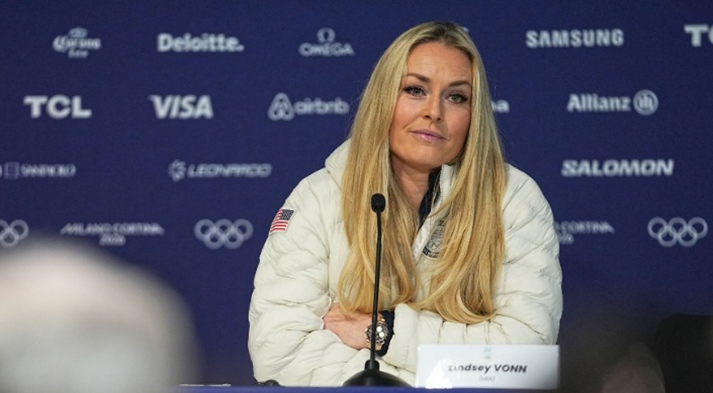

I love the Olympics. I don’t care whether they’re Summer or Winter, and if there were more of them, I’d watch every single one. On one hand, because I love sports, but on the other and, above all, because it’s an event where so many human stories come together through athletes who have spent years preparing for it.
In sports, I became interested as a child. In the human side, when I started college and decided to dedicate myself to it y. After all, my work as a physiotherapist does not consist only of assessing knee injuries and prescribing treatment plans but, above all, of understanding the people who suffer them and ensuring that those guidelines make sense to them.
The Milan-Cortina 2026 Games will always be remembered for the story of skier Lindsey Vonn. The rest had a hard time matching her media attention, even if they broke records. Johannes Høsflot Klaebo tried, sprinting uphill at 17 km/h in the cross-country event, but even that wasn’t enough (at least he took home the gold). Sturla Holm tried too when, after being asked who he dedicated his medal to, he publicly confessed to infidelity as a last-ditch effort to ask for forgiveness, but that didn’t work either (and on top of that, she didn’t take him back). And thanks to her, many people who weren’t even into skiing followed the competition, and specifically what happened on Sunday, February 8th in the women’s downhill final.
What happened that day was just the most visible tip of the iceberg in a story that had started for Vonn long before. And if it has been so widely discussed, it’s not just because it brought attention to issues like knee injuries or decision-making in elite sports, but also because it touched on many deeper themes beneath the surface—such as the role of healthcare professionals, individual values, mental health, social stigma, and even freedom itself.
So first, we’re going to walk through her story in detail in order to analyze this case and reflect on everything we can learn from it.
LINDSEY VONN: SKIER
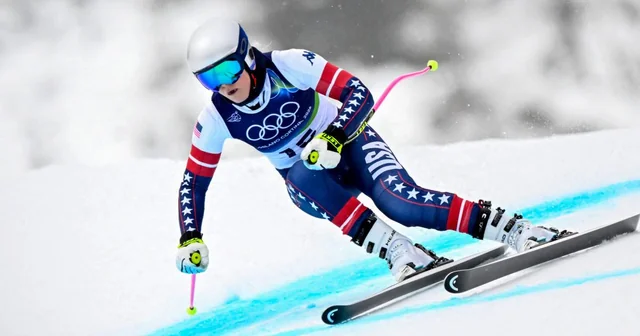
Vonn was born in 1984 in Minnesota, United States. Her father had competed at the national level in skiing as a junior, but he got injured, specifically no, the knee. Because of this, he retired to become a lawyer, while always staying connected to skiing as an instructor. Lindsey started going along in his backpack when she was just 2 years old.
At 9, she met the skier Picabo Street in a store, where she signed a poster for her and they were able to talk for a few minutes. She says that at that moment she knew her dream was to become an Olympic skier. Her father then sat down with her to map out a plan, and for several years her family repeatedly traveled to Vail, on an 18-hour car journey, so she could train. Until, when she was 12, her parents decided to take the leap and move the whole family to that city, which meant leaving everything behind for her and her family.
Some coaches in the youth program believed she wouldn’t amount to anything. Vonn was very aggressive on the downhill, made mistakes, and wasn’t always the most disciplined. Some thought she wouldn’t have the consistency needed to succeed at the elite level. She herself has said that those comments motivated her even more to prove them wrong.
And she did. At 20, she achieved her first victory in a World Cup race. From there, she went on to win 4 World Cups and two Olympic medals, gold and bronze, at the Vancouver 2010 Games, becoming one of the most prominent skiers of her time at the age of 26.
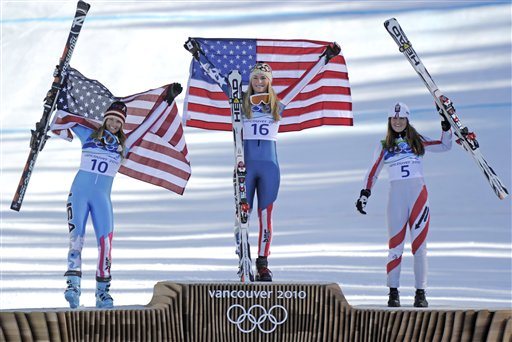
Until, in February 2013, while competing in Austria, that day arrived. Tthe kind that many get through but others never forget, when she suffered a serious injury to her right knee: anterior cruciate ligament (ACL) tear + medial collateral ligament (MCL) tear + tibial plateau fracture.
As a downhill skier, of course, it wasn’t the first time Vonn had been injured. She had already gone through fractures of fingers, her forearm, and even a concussion. She would lose count of the many contusions. Because any skier knows that crashes are part of the job due to a major risk factor that is, at the same time, the very foundation of the sport: speed.
According to the official results in Milan-Cortina, the average speed of the skiers in the downhill final was 55 mph, reaching 81. And they wear helmets, but not the chassis of a Formula 1 car around them. It’s only recently, since 2015, that the International Ski Federation has required the use of airbag protection systems under the racing suit, which still cannot offer the same level of protection as a car system at the same speed.
So Vonn went into surgery for her knee. And, as is common in elite sports, after 9 months she was already training at full intensity to make it to the Sochi 2014 Olympics. It was then, in November 2013, that during training she partially tore her ACL again. And in December, completely. For that reason, she announced she would not compete in the Olympics. Unfortunately, up to that point, all of it was very typical in elite sports.
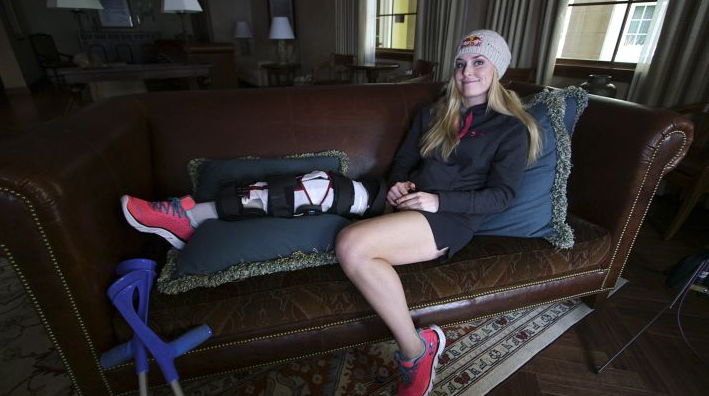
Vonn remembers watching the Sochi 2014 Olympics on television as something extremely painful. She was 30 years old and, for the next ones, she thought she would be “too old.
One year later, in December 2014, she made a comeback after another round of surgery and rehabilitation. And she did so impressively well, getting close to the all-time record for World Cup race wins. But at the same time, she publicly stated that the pain in her knee was constant and that her body “no longer responded the same way.”
In November 2016, she suffered yet another crash. “I always check my knees first and I felt they were fine”, but she noticed her right arm was hanging: humerus fracture with nerve involvement causing motor deficit in the hand. She underwent surgery and, by the end of January 2017, she won another World Cup race. An amateur would probably still be processing the trauma after those two months. A skier accepts it as something normal and frequent, asks for a solution, gets to work, and is already focused on recovering in order to return.
In 2017, when asked about her injuries, she shared how her family had told her it was time to retire because she was going to end up disabled. Her response: “If I have to go cripple I will. And I trust that when I retire, medicine will have solutions to heal me.”
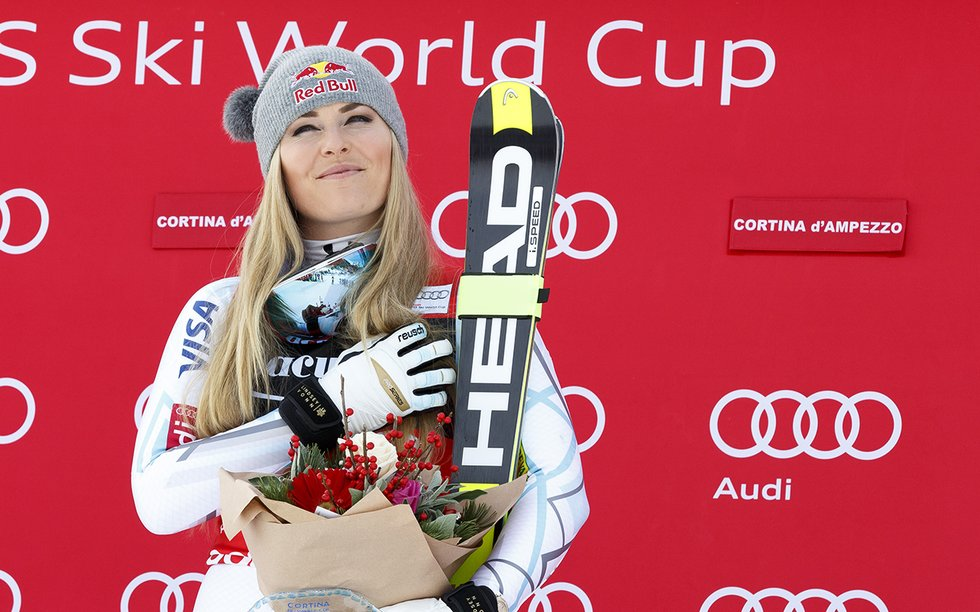
Always dealing with the consequences of her right knee, Vonn managed to return to the next Olympics and won bronze in the downhill at PyeongChang 2018. She also achieved numerous victories in World Cup races, reaching the all-time women’s record with 82 and falling just 4 short of the men’s record, which at that time belonged to Ingemar Stenmark.
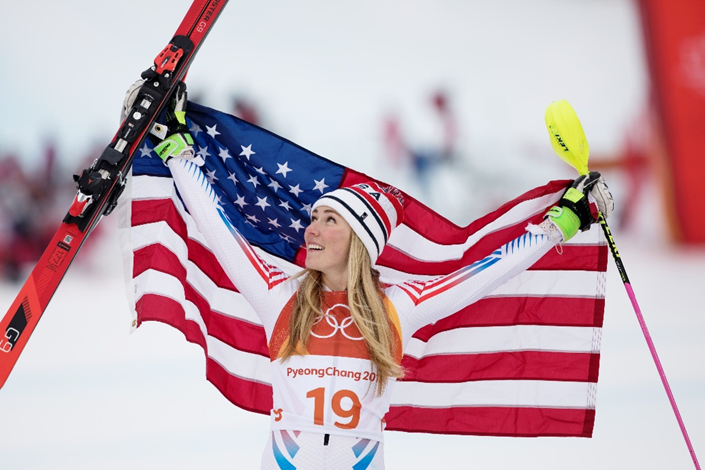
Months after winning the Olympic medal, in November 2018, she suffers an instability in hyperextension on her other knee. On this occasion, there are no complete tears, remaining as a ligament sprain.
By 2019, Vonn already has damage to the cartilage in her right knee and suffers severe and disabling pain. At that moment her discourse changes and in an interview for CNN she expresses out loud:
“It is very scary to think about not having something you love so much, but I also want a future”
She knew that the moment would come for every athlete, but it was not easy to accept it, and even less for this reason. She felt that “mentally I could win, but the turbine was broken and there was no mechanic who could fix it”. And she began to feel that, compared to the risk of a disabled future, it was no longer worth it for her to win more medals.
It is then when, after making this personal assessment of the risk-benefit, she announces at the age of 34 and with a record-breaking career, her retirement from sport after taking part in her last World Cup race in Are. In her statement she writes:
“My body is shouting at me to stop and it is time for me to listen to it”

NEW LIFE AFTER RETIREMENT FROM SPORT
Vonn says that this is when a painful but necessary process began, one that many athletes go through: who was she outside of skiing? And when you look at it in perspective, it’s hard for this not to happen to any of them. You grow up building your identity around a single element, sport, which takes up so much of your life that it turns you into a one-dimensional being. And on top of that, since sport is supposed to be very good for both your physical health and your social life, and if you’re also very good and win titles, what problem could there be? Why pay attention to your identity outside of it?
Maybe thanks to athletes like her and others from her generation opening up and sharing their experiences, these situations are more visible today. Vonn fell into depression, so she underwent psychological therapy to begin getting to know herself as a person and not as a skier, and in which it helped her start to set new goals.
With an estimated net worth of 14 million dollars at the end of her career, she remained connected to the world of skiing as a commentator and sports analyst on television and also started other projects outside of it.
She resumed her studies, which had been interrupted after high school. Vonn was not able to attend college due to her competition schedule and felt the need to better prepare for this new stage that was beginning. That’s why she enrolled in an executive program at Harvard Business School.
She created the company Après Productions, dedicated to producing content for film and digital platforms, telling inspiring stories about determination and resilience that, she says, she wants to bring to people.
In addition, she focused on something very special: her foundation dedicated to empowering girls. After her experience growing up focused on performance and titles, she started this project with the goal that younger girls learn to distinguish what they need as athletes and what they need as people, helping them grow with proper mental health. She also published her first book, “Strong is the New Beautiful”, about lifestyle advice, and later her biography, “Rise: My Story”.
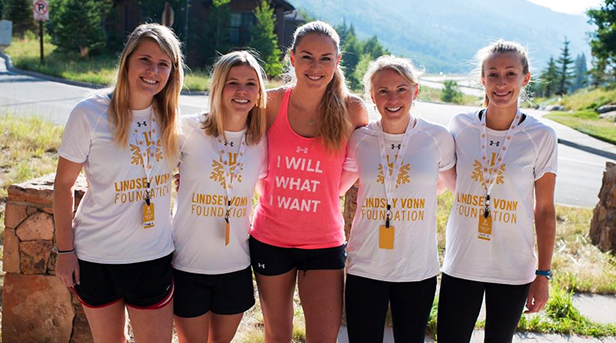
And, at the same time, she continued to suffer from the problems she had in her right knee. Because, as we well know, these injuries do not go away on their own the day you retire from sport, but their consequences stay with you in everything you want to do outside of it. Vonn even said that her body was “older than her actual age”. She experienced pain when walking for more than ten minutes, going down stairs, difficulty getting up after sitting… and all those things we are familiar with.
She underwent numerous biological treatments, but she was aware that her situation was basically about how long she could delay a prosthesis and how many replacements she would need throughout her life. And she searched, informed herself, and compared information. She explains in an interview that there were total or partial ones, that in some they removed the ACL and in others they preserved it, that sometimes they were placed with robotic assistance. The kind of informed patient that, honestly, you wish would explain things that clearly even as a doctor.
It was six years after her retirement when, as a result of this search and given the limitations both in daily life and in staying active, Vonn underwent unicompartmental knee replacement surgery in April 2024. That is, the replacement of the damaged cartilage surface with a metal component. In her case, it was performed in the lateral compartment using MAKO robotic-assisted surgery by Dr. Martin Roche.
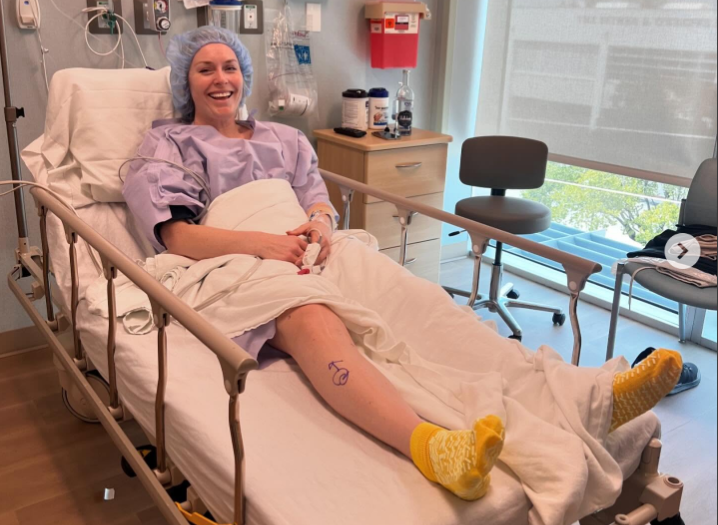
At that moment, Vonn stated that she wasn’t closing the door on anything, but she did not present the surgery as a plan to return to competition. Her goal was to regain a pain-free life, feel physically strong again, and be able to ski recreationally.
And she felt that improvement immediately. She explains that this recovery is different from that of ligament or meniscus surgery, where you have to wait for healing (again, an informed patient who even understands biological timelines). Because with a prosthesis, you directly have a new surface, which is perceived as a big difference from the start.
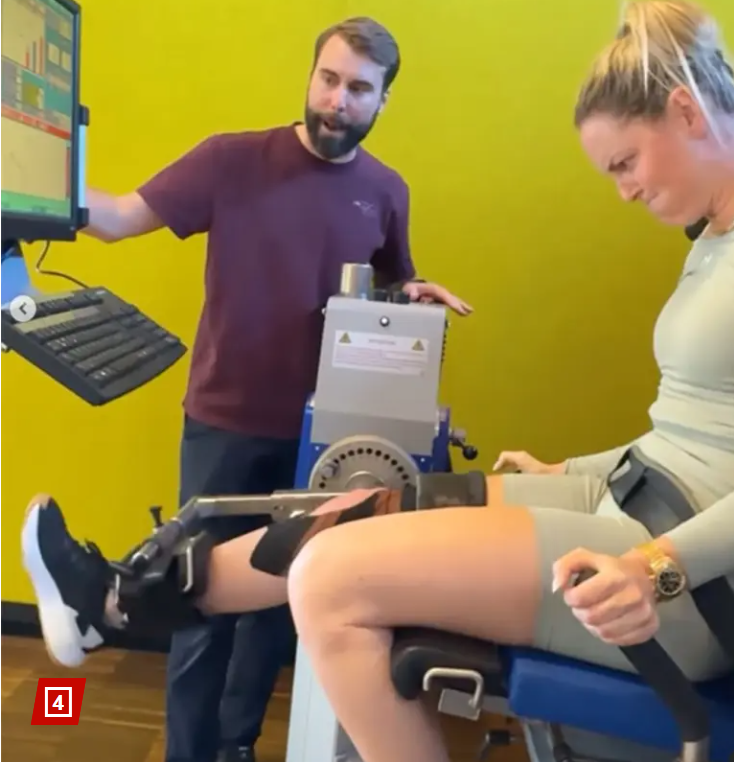
She went through an intense summer of rehabilitation and, being the United States, we can predict with a high degree of certainty that Physical Therapy was not based on cranial osteopathy with neuromodulation. And she begins to take one step at a time. She runs again. She skis again. She pays attention to herself because she expects that moment “when the pin is going to drop”, that is, when she starts to feel some discomfort in her knee telling her “this is as far as you go”. But that moment never comes. She feels it “like new” until, without expectations, she finds herself at the doorstep of the final step: returning to competitive skiing.

TO COME BACK
It is then when she announces her return to competition at the end of 2024, explaining that she does not approach it as an obsession, a goal of records, money, sponsorships or media exposure, but for a simple reason: downhill skiing is still her passion. Why not enjoy closing the circle in a different way, this time without pain and, on top of that, with the excitement of knowing that the next Olympic Games were on the slopes of Milan-Cortina, which she considered her home.
Amid the excitement, Vonn also encounters something she did not expect: criticism. She herself expected some questioning because of returning to compete with a prosthesis, basically because no one had done it before. But not the judgments she received about her as a person, saying that she did not know how to live without skiing and that she needed to see a psychologist.
In the interview broadcast on the program CBS Sunday Morning, she gives explanations (and from that point on she would not stop giving them) to everyone who judged her:
“Retirement from sport was incredible for me because I learned who I was without skiing, and now I think that gives me a different perspective. I don’t need to ski. I am Lindsey, I am not a skier. I am a person who loves skiing, and that is a very big difference for me, both in my mind and in my heart. I no longer need skiing in my life, but I still love it«
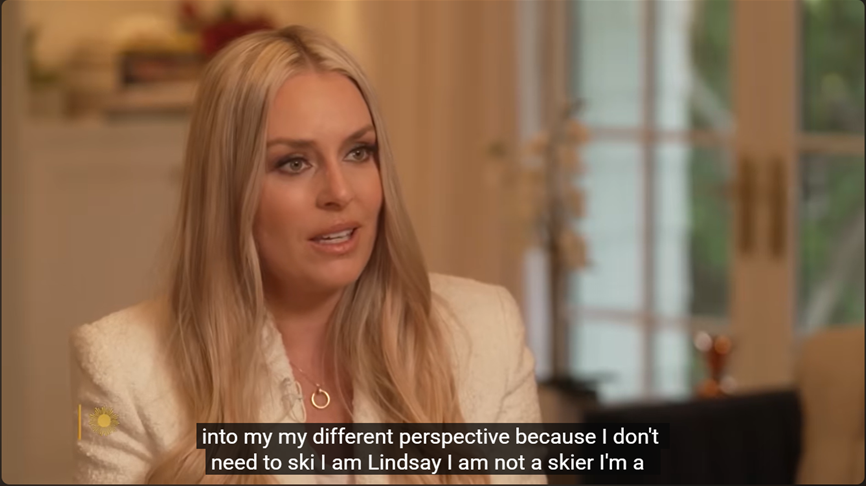
Vonn also explains something very human about these criticisms: that she has tried not to let them affect her, but it has been difficult. Because they did not come from anonymous people, but from former skiers whom, she explains, she respected. With her experience and career, Vonn is surely a mentally strong person, but a person nonetheless.
She also comments that, although she of course likes to compete, she is returning from this situation without expectations. But that, at the same time, she knows there will be many people watching her, hoping that she achieves something special, and that she is aware that it will be a different kind of pressure that she will have to handle.
NOW THE GOOD PART BEGINGS
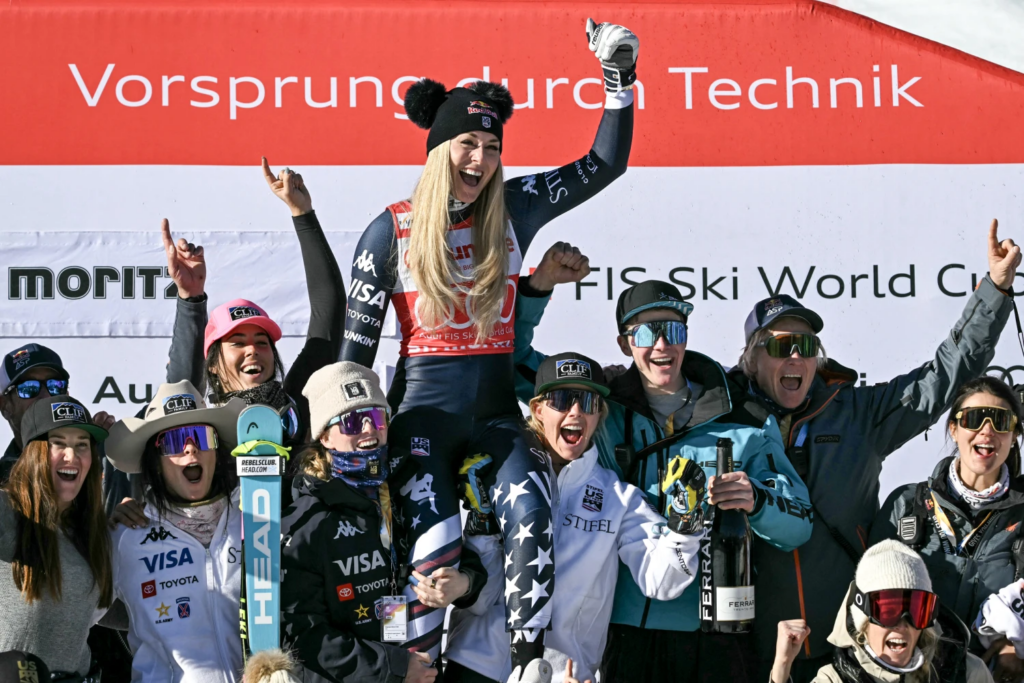
On December 7, 2024, Vonn returns to downhill competition in Copper Mountain, finishing 27th out of 45 competitors. She competes regularly on the circuit and it is in March 2025, almost one year after the prosthesis surgery, when she surprises the media by achieving silver in Super-G at the World Cup in Sun Valley (USA). Her first podium since her return.
But Lindsey Vonn’s name truly returns to the media on December 12, 2025, when she wins the World Cup downhill in St. Moritz (Switzerland). With this victory, she becomes the oldest skier to win a World Cup race (41 years old), six years after her last victory.
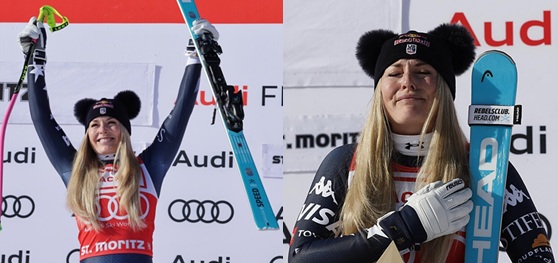
At this point, Vonn not only becomes a media figure within the world of skiing, where she was already a legend, but she also begins to be known outside of it. Sports fans who are not involved in this sport start to recognize her name. Also in Spain where, although we have mountains, since Paquito Fernández Ochoa, skiing has not really managed to draw our attention away from football, even though Vonn had been awarded the Princess of Asturias Prize in 2019.
In this victory, Vonn makes a statement that many physiotherapists surely shared with our patients: that it was not a matter of getting a prosthesis and going out to run. Rather, that intervention had allowed her to rehabilitate and train until she reached the best physical condition of her life. Behind this there was not only talent, but also a great deal of work and effort.
Social media echoes her achievement and many begin to follow her closely, curious about her next goal: the Winter Olympic Games that would take place in a month and a half.
I heard about her for the first time a few months earlier, when a patient with a cartilage injury told me during a consultation that “she felt reassured because, seeing Lindsey Vonn, she knew she would always have the option of a prosthesis to return to sport. Don’t you know who she is?”
Since, if there is something that interests me above knee injuries, it is the people who go through them, I started reading about her story. I saw that she had a book that I couldn’t manage to buy (I don’t like eBooks). I tried in different Barnes & Noble stores when I traveled to the United States in October, but no luck either. But there was plenty of my favorite resource: long, in-depth interviews, the kind where people have time to open up, and Vonn does so in every single one. Conducted at different moments throughout her career up to the present, they were also some of the ones I have most enjoyed listening to while driving. Ultimately, I am a woman born in the same year as Vonn, and I feel very close to many of the things she talks about.
MILAN CORTINA 2026 OLYMPICS
We were almost there, both longtime skiing fans and newcomers after learning about the Vonn case, when on January 30, while competing in the final race in Crans-Montana before the Olympics, she suffered a heavy crash. She went wide on a turn and slammed into the net. She got up on her own, holding her left knee, and we all feared the worst. Two more skiers crashed, until the organizers decided to stop the race due to poor weather and slope conditions, but the damage for her had already been done.
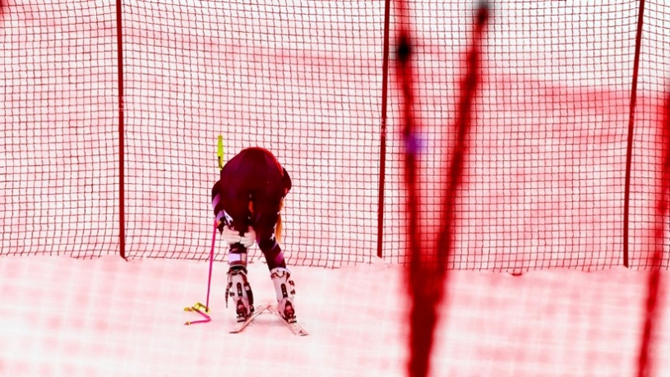
For Spaniards, the sudden memory of Carolina Marín in Paris 2024 came to mind, when she tore it again in the middle of the Olympic semifinal while in the same situation as Vonn, very close to pulling off the feat of becoming champion again after a long break due to a knee injury. And indeed, the diagnosis was confirmed: Vonn suffered an ACL tear in her left knee along with possible meniscus injuries. And this while she was leading the World Cup. We couldn’t believe it.
After a few days, she reappears at a press conference to talk about it and announces to us:
“After several medical consultations, intensive physiotherapy and many tests, today I have managed to ski for the first time since the injury, so I have decided that I am in condition to compete in the downhill event this Sunday. It is not what I had planned, nor how I wanted to get here, but I still believe that I can give my best in these Games. I know my chances are not the same as before the injury, but as long as there is a chance, I am going to try and I will do everything in my power to be on the start line”

A reasonable debate immediately begins in the media and on social networks. From the accident to the Olympic race there are exactly 9 days in which, beyond a torn ACL, what concerns doctors and physical therapists is the acute state of that knee: pain and joint effusion that will be reflexively causing muscle inhibition. That is why not only the passive stability of her knee is compromised, but also the active stability. Skiers can reach speeds of 81 mph, one wrong move and the chances of causing more damage to that knee or suffering a serious accident would be high.
As always, two sides emerge: the fans of “Go Lindsey! You got it!” and the haters saying “she’s going to crash.” Then comes the typical appearance of a third group, the haters of the haters, even though they think they are not. Between all of them, Vonn receives many judgments such as, once again, that she is doing it because her life is empty if she doesn’t ski or, something that I personally find very striking, what she should value as a person.

If she had already received criticism for returning to competition at 41 with a prosthesis, the criticism now becomes endless. Her mental health is questioned, and even social stigmas such as her age are brought up:
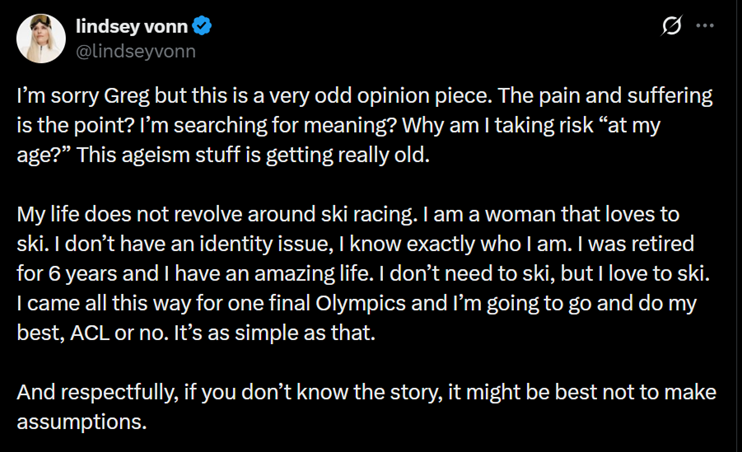
And even if we take her mental strength for granted, we should emphasize that Vonn is a person: the reasonable anger that not even the most enlightened Buddha can avoid feeling in a situation like this leads her to spend part of her energy responding, when it would have been more beneficial to focus it on her Olympic races. The only one benefiting from this situation, beyond the media, is at least skiing, since no one will miss Sunday’s final to see what she does. Even more pressure.
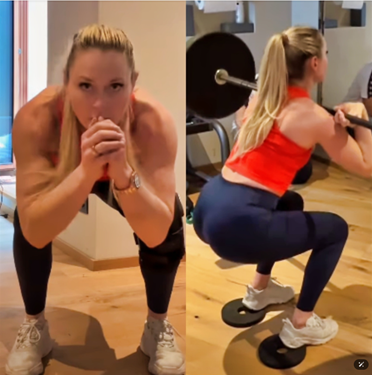
Meanwhile, during that week, she shares a video of her rehabilitation as a coper patient (those who choose to return to sport without undergoing surgery). Some of my patients tell me that in the first week they weren’t even able to walk without crutches, and here she was jumping and doing deep squats.
But then comes the real test before the big day: the official training runs. Vonn completes two runs on the slope where the final will be held and achieves the third-best time, reaching a speed of 80,7 mph. And she shares one last message before the final in which, as has been usual since her return, she continues to give explanations:
“But why? Everyone seems to be asking me that question. But I think the answer is simple… I just love competitive skiing”
AND FINALLY THE DAY ARRIVED: THE OLYMPIC DOWNHILL FINAL
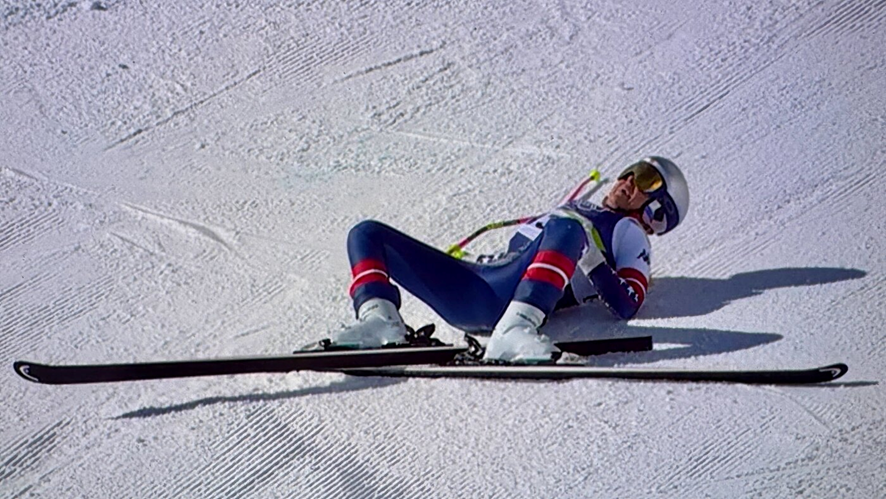
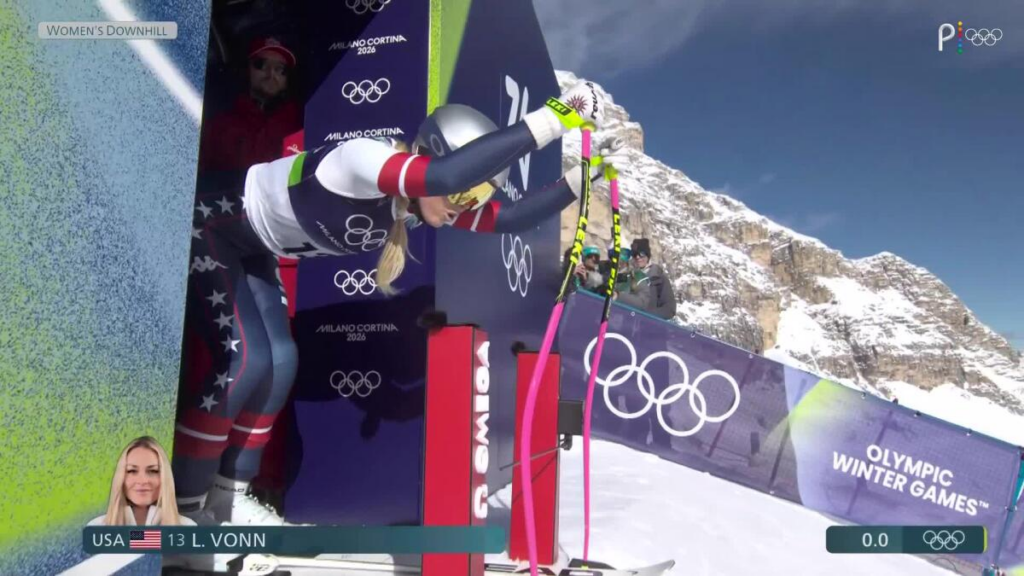
Vonn starts in position number 13 (for the more superstitious). And it is exactly at second 13, when she had barely begun and the commentators were just finishing telling her story to move on to the race itself, that she suffers a heavy crash and remains lying in the middle of the course.
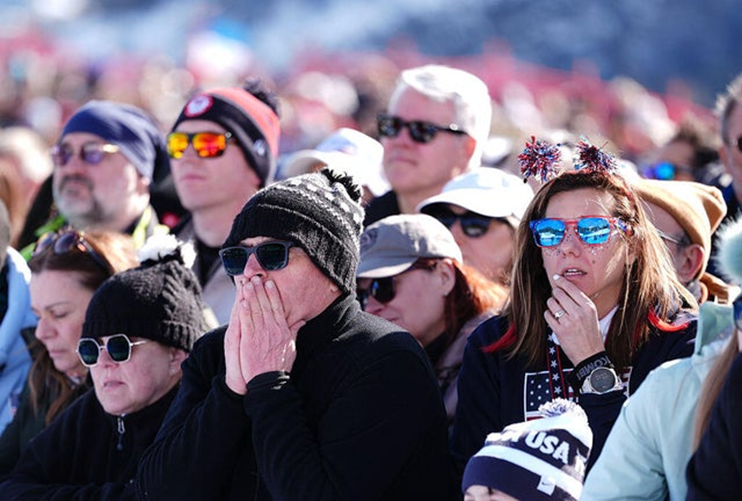
Silence. Not only in people’s homes, but the kind you could feel in the stands themselves, where a crowd remained standing without daring to say a word. Even the commentators fall silent. A silence I will always remember because I had never experienced one like it at any sporting event. Surely caused by concern but also, in this case, by the genuine disbelief that this had just happened. Deep down, we all always want a happy ending to the story.
The silence is broken by Vonn’s screams as she lies on the ground. The crash has been very hard and she has taken multiple hits. Medical assistance on the course arrives, and the rest of the skiers coming behind try to stay focused. Vonn is evacuated by helicopter.
BUT IN THE MEDIA AND ACROSS SOCIAL MEDIA…
No, in this case the effect is completely the opposite. The group of supporters argues that she could have done it, the haters say it was obvious. The haters of the haters say it’s very easy to say that once it has already happened. Some try to take advantage of the moment to make content go viral, others genuinely try to offer professional opinions from an honest perspective. I’m left with a knot in my stomach.
I rewind the video several times on RTVPlay to see if something related to her left knee had happened because, between the speed of the action and the cloud of snow that had surrounded her, nothing could be seen. And I see that the crash had not been caused by something directly related to her knee, but because her right arm got caught on a gate. A little later, with the race continuing live on the screen, I also see how the Andorran skier Cande Moreno suffers a mechanism after a jump and injures her knee. I decide to turn off the computer and go for a run. Who needs to get into thrillers.
But, like many others, I don’t take my attention away, neither that day nor in the days that follow. And not because of a knee injury, that begins to move into the background, but because many more debates start to emerge around a person. I stop to read and watch many kinds of analyses and comments.
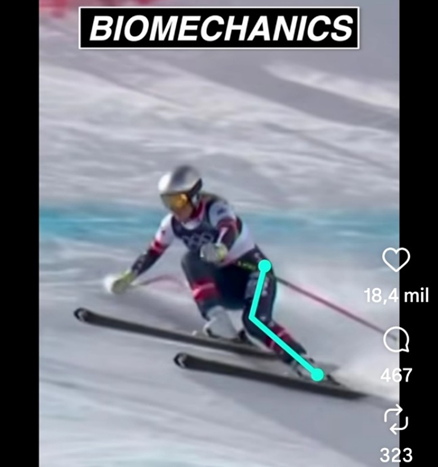
Regarding the crash, some explain that there is a valgus collapse of the left knee when trying to turn before reaching the gate, and they even point out that an anterior drawer can be seen. Others say no, but that undoubtedly it is the lack of stability in the knee that causes her to make that turn incorrectly and get caught. Others argue that what happened has no relation at all to her knee, since she simply takes a very aggressive line and gets too tight.
Regarding her decision, once the race was over and what had happened had happened, she is labeled as reckless, overly ambitious, someone who has poorly managed her personal life after retiring from sport. Some doctors use her as an example so that patients can see how dangerous this kind of bold move can be. Many, both professionals and non-professionals, point out the irresponsibility of her medical team for allowing it. Others applaud her as a hero and describe her as brave for having tried, considering her an example of resilience.
On Monday we learn the diagnosis: Vonn suffered a complex fracture of the left tibia, considered severe due to joint involvement in the knee and the degree of bleeding that occurred. Bones have blood vessels that can also break, and through them blood leaks out, forming a hematoma that puts pressure on the surrounding tissues, potentially cutting off their blood supply and therefore even posing a risk of amputation. For this reason, she required urgent surgery and several more during that week.
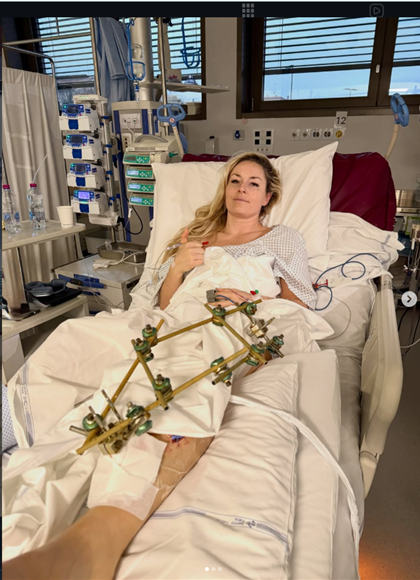
In the following days, Vonn shares a photo with the external fixator that had been placed, in which she reiterates a firm message: that she does not regret it. That she knew the risks and chose to accept them. That she will never forget the feeling at the start gate. That this is not the end of a book or a fairy tale, that it is simply life. And also, that her previous ACL injury had nothing to do with what happened.
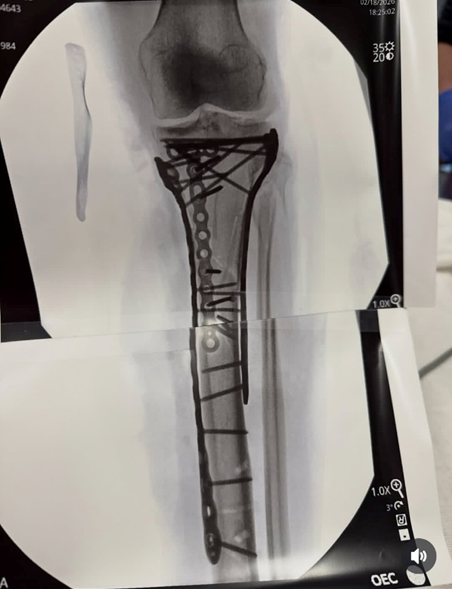
On February 20, already back in Vail after being stabilized, Vonn undergoes surgery by Dr. Tom Hackett to reduce the fracture, finally sharing the image of the “crime scene” that, especially healthcare professionals, had been curious to see. A Schatzker type VI fracture requiring extensive reduction with osteosynthesis material to support the tibial plateau and the diaphysis:
A few days later, already discharged and transferred to a hotel, and after two weeks lying in a hospital bed, she shares that, to make matters worse, she has a fracture in the ankle on the opposite side, so she begins her rehabilitation process in a wheelchair. Vonn also shows herself as she feels, visibly affected, and states that these are being mentally tough days.
Some continue debating, at best: was it related or not to the previous ACL injury? But the criticism toward Vonn is endless and even out of control. She is directly labeled as a crazy egocentric person. Many mock whether she will go to the Paralympics and, on X, an anonymous user spends their time creating an AI-generated video from a photo of Vonn in which she is shown doing a downhill run in a wheelchair. There are also many who praise her, most often using words like hero, brave, and inspiration.
And, having listened to all kinds of points of view, I will add one more after everything this case has made me reflect on.
- REGARDING THE ACCIDENT: DID THE LEFT KNEE INJURY HAVE ANYTHING TO DO WITH IT?
Let’s analyze it so we can reason it out. It happens at gate number 4. The section just before included a turn with a reverse camber (opposite to the natural slope of the course), which the skiers had to negotiate by quickly adjusting their line in order to set up for the upcoming jump. As she passes through the gate, she crashes and a cloud of snow surrounds her, making it impossible to see what happened.
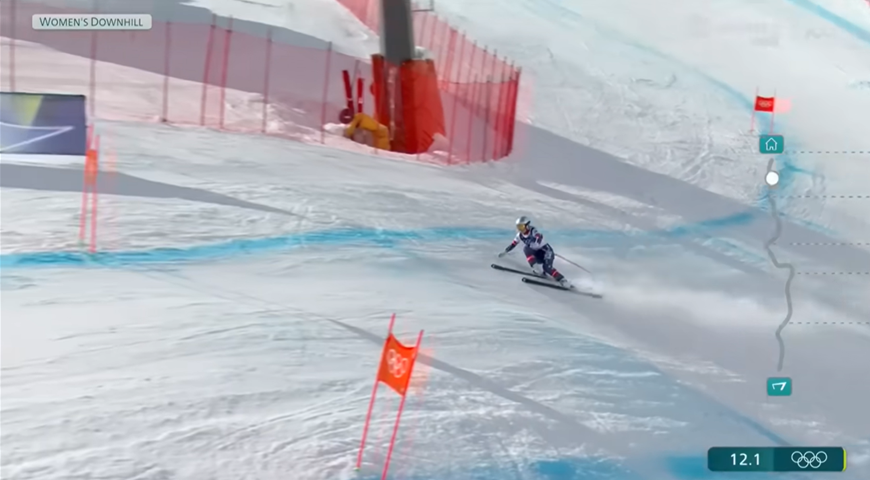
Rewinding the broadcast, what I specifically wanted to see was whether, upon landing the jump, her left knee had collapsed. This is exactly what happened to the other competitor who injured her knee in the same race, Cande Moreno, for whom an ACL tear was later confirmed. If the same thing had happened to Vonn, a direct relationship with the previous injury could have been established. But no, that is not what happens, rather, her arm passes very close to the gate and gets caught on it while she is in the air, which causes her to spin like a helicopter until she crashes.
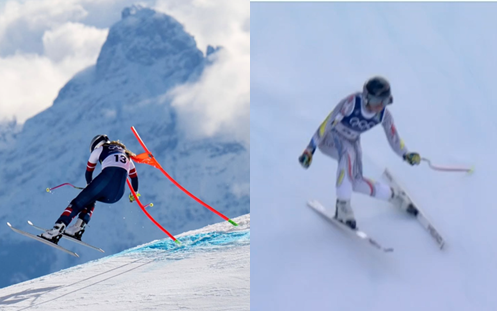
So, and with the image that will remain in Vonn’s story with the gate, the debate shifts to whether the fact that she passed so close and got caught had to do, once again, with her knee. And many professionals argue that it did, that it was because when making the turn her knee could not تحمل the valgus loads and that prevented her from executing it properly to avoid the gate. They even present the classic valgus vector analysis, commenting that “the tibia translates anteriorly and cannot hold because there is no ACL.”
I believe that simply watching the footage does not provide that level of information. That same valgus vector analysis could surely have been made on the runs she completed in training, because it is a natural movement and in those images there is no pathological degree that clearly shows a collapse. Not to mention that claiming to see anterior drawer, like the kid in The Sixth Sense, is like having an arthrometer in your eyes measuring millimeters of tibial translation as if you were a human KT-1000. Even with a brace on top, which apparently is still not an obstacle for some when it comes to “seeing” that displacement.
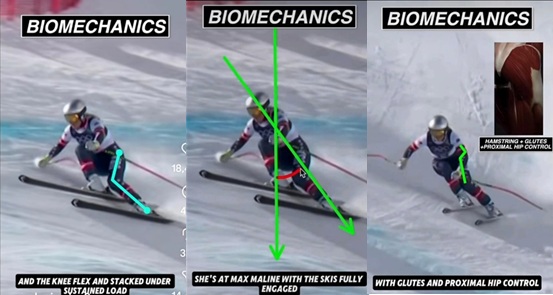
Quantifying how comfortably she made that turn in relation to the state of her left knee is something that can only be measured by her own subjective perception, and Vonn’s statements were unequivocal: the crash was not related to the condition of her knee. Anyone who doesn’t want to believe her is free to do so. But those who do can rely on a solid argument: this sport is about taking the most aggressive lines, that is, the straightest ones between gates. And in fact, this type of accident with gates is common, even among skiers with an intact ACL.
Everyone has applauded Federica Brignone, double gold medalist at these Olympics just 9 months after suffering a tibia and fibula fracture plus an ACL tear. Interestingly, she sustained that injury in an accident very similar to Vonn’s, taking a line where she got caught on a gate. Brignone was not coming off an ACL tear, and it still happened. Because there is never a single cause behind this type of accident.

And the reality is that impacts with the gates happen often and, at that speed, they hurt. Skiers usually have their arms covered in bruises from those hits. And if they are so frequent, it’s because, as we’ve already explained, if we reduce skiing to its most basic form, it’s a sport where the winner is the one who goes down taking the straightest possible line without crashing. And that means, yes, passing as close as possible to the gates.
So how can we be sure, just from what was seen, that in Vonn’s case it was due to how her knee felt? I won’t deny those who think so that her knee would not have been in its most optimal condition just 9 days after an ACL tear, but I also won’t agree that it was definitely the cause as if it had been the same mechanism as Cande Moreno’s.
Personally, I believe that, regarding the knee and given how things unfolded, we will always be left with the doubt of whether it would have tolerated the demands of a competition final.
2. REGARDING MANY OTHER DEBATES THIS CASE HAS OPENED IN THE WORLD OF SPORTS
And beyond it. Because at this point, the knee injury was no longer the main issue.
THE US FEDERATION SHOULD HAVE CALLED UP ANOTHER SKIER
The United States could include four skiers per event, and this is decided based on objective criteria, which are the results achieved by each athlete. Number of World Cup victories, consistency in a specific discipline, etc. If a skier meets certain minimum results, she earns a spot almost automatically. It is only in the case that there are more than four candidates with a similar level that the technical committee steps in, assessing factors such as physical condition, adaptation to the course, medal strategy, and so on.
Vonn did not earn her spot for the Milan-Cortina Olympics because of a pretty face. Nor because she had come back after being a legend, nor because she now had a prosthesis. But rather, indeed, because of her results.
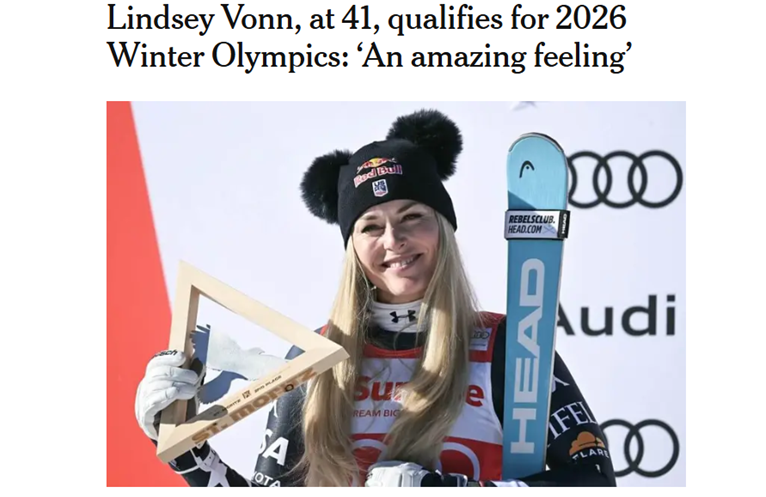
When the crash happened in which she tore her ACL, she was leading the World Cup in the downhill discipline and, moreover, in a dominant way. So much so that, even after missing the remaining three races, she still had a chance to win it. She had been on the podium in 7 out of the 8 races she had competed in, and in the one she didn’t, she finished 4th. Despite everyone saying she wouldn’t be as fast anymore and that she was too old, she was not only the best, but she was also performing exceptionally well. That’s why she earned her spot on merit.
Making it to the Olympics was already a major success, the result of very demanding work she had to put in to reach that level, which was by no means recognized as it should have been amid so much judgment.
It is when she tears her ACL that, in addition to everything she had already received, she is also labeled as selfish for not giving up her spot to another American skier who could have competed in better conditions and, therefore, aimed to contribute to the medal count. This criticism is shared with the one directed at the U.S. Ski Federation, which is judged as keeping Vonn on the team because of her name or her track record.
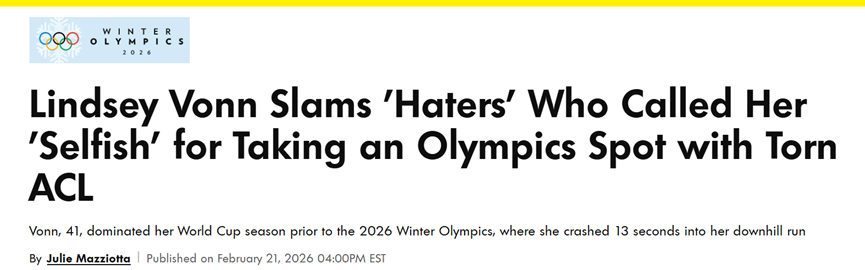
Regarding Vonn, if she had been occupying something that had been given to her out of generosity, she could have been labeled as lacking it herself. But we are talking about her occupying something that she, and not another skier, had earned on her own merit. If she had decided not to participate, another skier would have had the stroke of luck of finding herself at the Olympics without having qualified. But if she decided to participate, as was the case, no one can judge her for making decisions taking herself into account rather than a medal count. And that is not selfishness, but self-respect.
In the 2014 Champions League final between Atlético de Madrid and Real Madrid, Diego Costa started as he usually did. The key detail was that just seven days earlier he had suffered a hamstring muscle injury. To speed up his recovery, it was widely reported in the media that he had traveled to Serbia to undergo a treatment involving mare’s placenta. Nine minutes into the match, Costa made a sprint and, showing clear signs of pain, had to ask to be substituted. By the end of regular time, Atlético de Madrid was leading 1–0, but their players were physically exhausted. Juanfran was barely dragging himself around and looked like he needed a hearty stew, but all substitutions had already been used. In the 93rd minute, Sergio Ramos scored the equalizer, and Atlético de Madrid lost what could have been their first Champions League title.
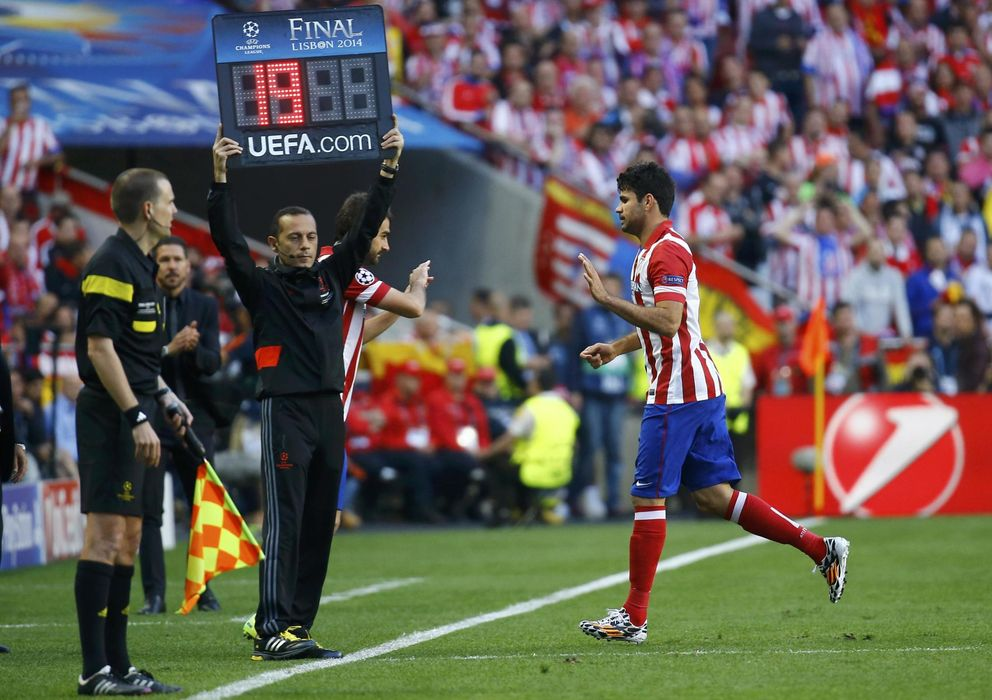
Equating the decision made by both Costa and his coach in a team sport—knowing there was no real chance of a muscle injury healing in just one week—with Vonn’s situation is simply failing to properly analyze the circumstances.
Regarding the U.S. Ski Federation, this case reminds us of Danusia Francis at the Tokyo 2021 Olympics. This Jamaican gymnast qualified for the Olympics for the first time at the age of 27 after many attempts. And, just a few days before the start, she tore her ACL in training. The same situation as Vonn.
Gymnastics is a sport that involves major decelerations, especially in dismounts, where the moment of sticking the landing is highly influential in scoring. Given the nature of the sport, she arguably had it even worse than Vonn, and her desire, likewise, was to compete. What did the Jamaican Gymnastics Federation do in this case? Support her.
Francis competed only in the uneven bars event, withdrawing from the floor, vault, and balance beam events she had planned. And in the event she did compete in, when performing the dismount, she did not execute a double salto with a twist, but simply opened her hands and let herself drop. Zero points. And in this way, Francis, surely not in the way she had expected, was able to fulfill her Olympic dream.
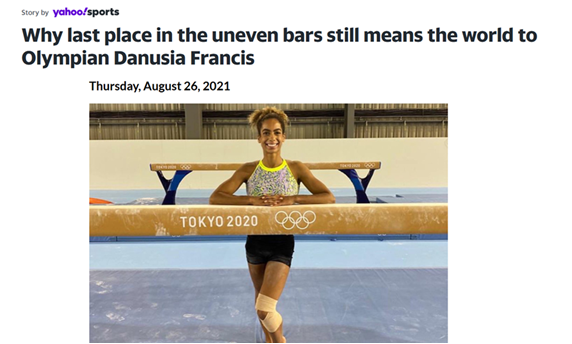
And this was the way a federation prioritized the athlete over the medal count and the person over the result. Perhaps some cannot afford to do so because they depend on medals to secure funding or investment. But those who can, I believe it is worth applauding that, in a meritocratic society, the person is supported for once.
So quite the opposite. Thank you, Lindsey, for an example of self-respect, and thank you to the U.S. Ski Federation for setting an example so that, in this society, people come first.
THE RESPONSIBILITIES OF MEDICAL SERVICES
Many healthcare professionals and non-professionals were talking at the time about the irresponsibility of the medical team in clearing Vonn to compete after her ACL injury. And this opens the door for healthcare providers to reflect on our role and to share that reflection with the general public.

In youth football categories in Spain, when a player recovers from an injury, they need a doctor’s signature to return to play. It makes sense, because a minor may not be in a position to make decisions about their health. Their parents could do so, assuming that everyone looks out for what is best for their children, but this is reality and sometimes it is not the case (especially those who are eager for their child to become a professional). It is then that an external and qualified figure ensures this safety. But outside of this situation, in the rest of the cases we are talking about adults.
More and more in science, the one we like to rely on so much, is bewing talked about Shared Decision Making. For example, in the decision of whether or not to operate on the ACL, this is an area where a lot of research is being developed. In this model, the different healthcare professionals assess and provide a clinical judgment that is shared with the patient, in order to make the best decision together with him or her. This model not only involves the patient, who, let us remember, is the protagonist of the story, but also humanises clinical practice, moving us healthcare professionals away from the figure of a God-like authority. Where we do not place ourselves above patients and are the ones who judge them.
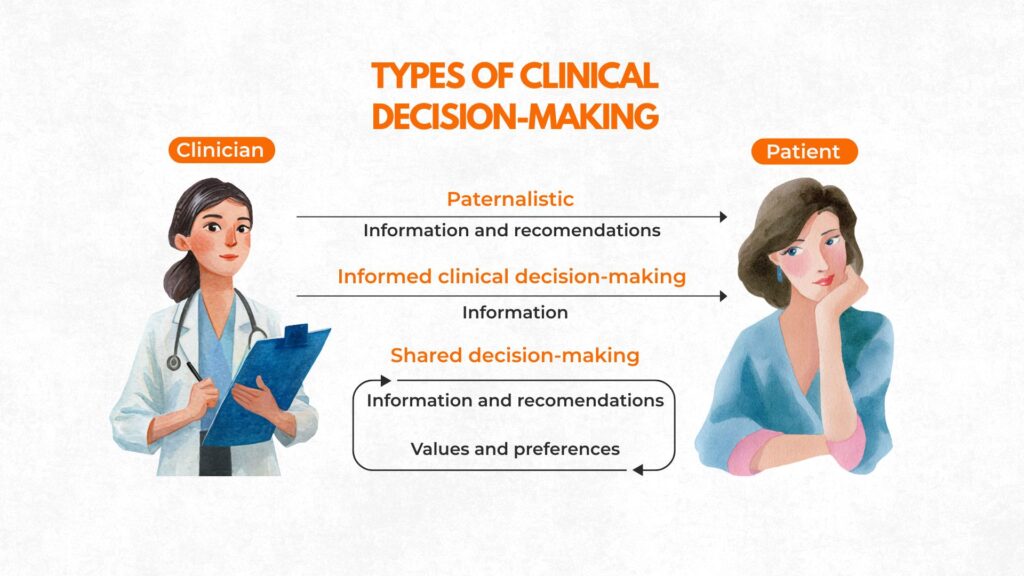
This, in a country like Spain, may sound like science fiction. Although going through difficult times, the citizens of this country benefit from a public healthcare system in which we are neither used to nor educated to think for ourselves. It is the doctor who, beyond critical or life-threatening situations, does not explain what the best options for you would be, but rather decides which one to apply. And not so much because of an egotistical issue within the medical profession, but quite the opposite: a lack of responsibility on the part of the patient. We are so fortunate to have this healthcare system that, at some point in history, we went from understanding that we had an exceptional tool to use as part of our responsibility for our health, to thinking that the responsibility for our health belonged to the tool.
Every day we see patients who, when asked something as what the surgery they are about to undergo will consist of, do not really know. They have delegated everything to the doctor.
When last year I did a clinical rotation in the United States, specifically at RUSH Chicago, one of the things that surprised me the most was not the prostheses for focal chondral defects or seeing a MACI implantation, but the attitude of patients during five-minute consultations with Dr. Jorge Chahla. An older man with a massive rotator cuff tear, who was referred to another doctor to assess a reverse prosthesis, asked whether there was any literature on the subject that he could read before the next appointment. My eyes were wide open. By the way, even with insurance, that consultation with the doctor costs around 300 dollars. If only for that reason, the level of individual responsibility among Americans, those who are so often criticised, may be so far ahead of us.

Last week, Carmen, a cleaner with a massive rotator cuff tear, set an example in Spain by asking her doctor what the surgery would involve, the one in which they were going to take a tendon from her arm and place it in her shoulder. Because, explained like that, she was afraid of ending up with a problem in that other area. Carmen was upset when the doctor’s response was “I know how to do my job” and she decided not to keep asking. When here a patient sets an example of the opposite, sometimes it is the doctors who are not used to it and allow themselves to feel questioned. And, instead of picking up one of those sheets used to draw explanations, they allow themselves this kind of arrogant response, failing in their most basic duties, such as explaining what a latissimus dorsi transfer involves to the person in whom it is going to be performed.
In the case of elite competition, even though athletes are adults, doctors once again have a legal role similar to that in the case of children. And not because, due to being athletes, they are considered immature, but because in this environment there can be so many interests or pressures that this system once again becomes necessary to protect them. And especially in one direction: the one that comes from above towards them. If it happens the other way around, where an athlete wants to take a risk, sometimes it is the doctors who have to protect them from themselves. The issue is where the lines are drawn.
“Not cleared to compete” decisions are made firmly, for example, in neurological injuries (concussion, temporary loss of consciousness), cardiovascular risk (findings suggesting risk of a sudden event), or hemorrhagic or internal injuries. But in Vonn’s case, with knee instability… where do you draw the line? Those of us who work in this field know how extremely complex this can be.
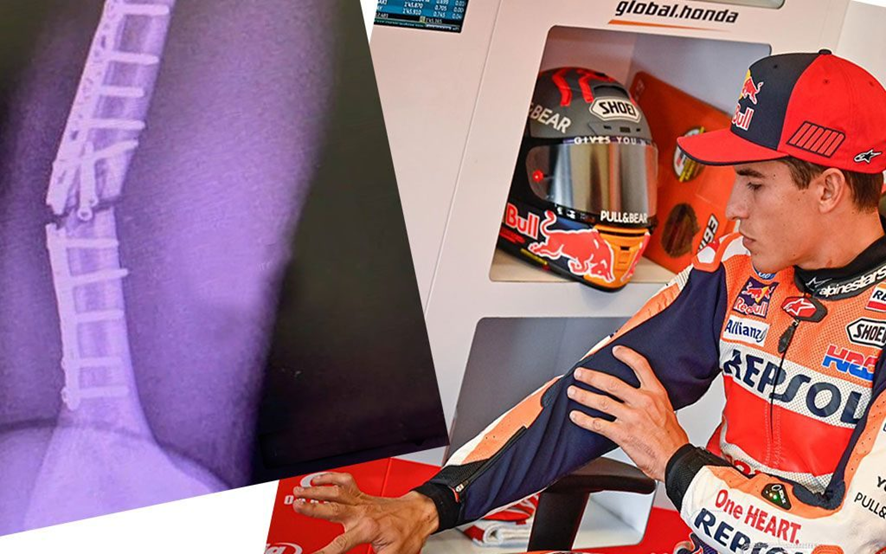
In July 2020, the Spanish rider Marc Márquez suffered a crash in which he sustained a humerus fracture and underwent surgery. Exactly four days later, he was taking part in practice for the Andalusian Grand Prix. The press said that Márquez had been given medical clearance, and one thing is what the media say has been said, and another is informing the rider about what his injury was, what had been done, what the next steps were, and what the risks would be if he chose a different path. Márquez chose his, and he had to undergo several more surgeries due to failure of the plate and a radial nerve injury that caused motor paralysis in his hand. Because four days after surgery, not just after an injury, it is highly unlikely that a metal plate in a bone can withstand the weight of a motorcycle. It is physics, and in this case physics makes the prognosis clear.
But when it comes to a non-operated knee instability… the spectrum for making this kind of prognosis is much broader. The first question that usually arises in clinical practice when someone tears their ACL is whether they should have surgery or not. And the answer is always the same: it depends. And not only on biological factors, how “strong” you can become so that your musculature compensates, but also on psychological factors (how committed you will be to treatment, your preferences, your beliefs) and social factors (type of sport, access to rehabilitation services, work situation, etc.). In other words, we must not only assess the knee, but also the person who moves it and their context.
In Vonn’s case, 9 days had passed, so with the acute phase still present and given the demands of the competition she was going to perform, any healthcare professional would have warned about the high risk she was taking. But she also had things in her favour, such as her physical condition at the time of the injury, access to specialised medical services, and her own experience with injuries. And faced with a functional assessment as comprehensive as the training sessions themselves, in which tolerance was adequate, no professional can determine a prognosis with 100% certainty. Here we can make a probable prognosis, but not a certain one like in Márquez’s or Costa´s case. So, with a prognosis like this, are we in a position to issue a “not cleared to compete” if the athlete’s will is to participate?
At the Milan-Cortina Olympic Games there has been a story similar to Vonn’s which, if it has not been as widely discussed, is not only because the injury occurred 4 months rather than 9 days before, but because it had a successful outcome: that of the Spanish athlete Ana Alonso. At the end of September 2025, she was hit by a car while training, in which she tore her ACL and MCL (in addition to suffering a shoulder dislocation and an ankle fracture). Quite something. And after the assessment by healthcare professionals, she made a decision—or rather, two: not to undergo surgery and to maintain her Olympic goals. Two bronze medals.
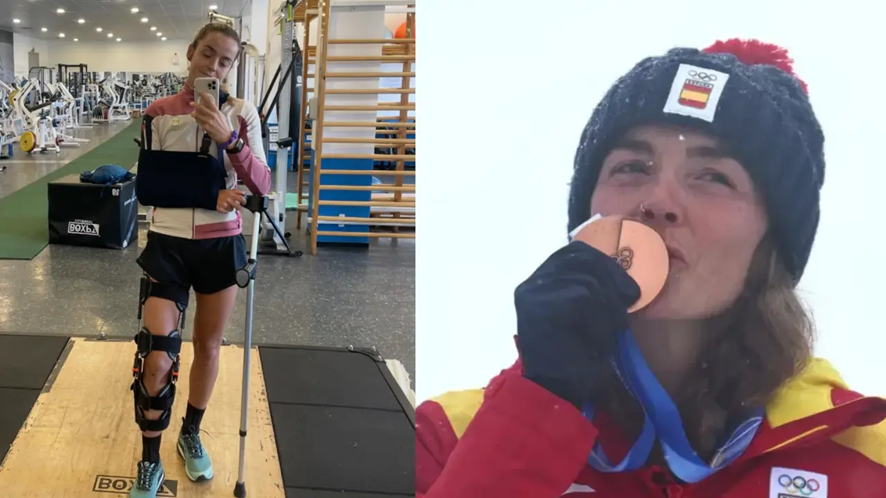
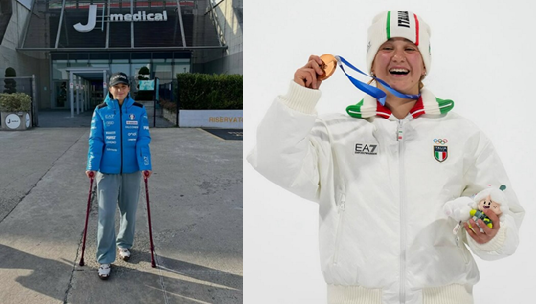
And not only that one. Flora Tabanelli, an Italian freestyle snowboarder, who tore her ACL while training on November 5 and made the same decision as Ana Alonso. Bronze medal.
Rell Harwood, an US freestyle skier, who tore her ACL while competing on December 13 and made the same decision. She did not win a medal, but finished in 23rd place.
Did all these athletes receive clearance from medical services because there was no risk? Of course there was risk. In Ana Alonso’s case, 4 months had passed, not 9 days, and the event she competed in—ski mountaineering sprint—does not place as high demands on the knee as downhill. Her percentage of risk would have been lower than Vonn’s, but it existed. In Flora Tabanelli’s case, it had been two months, and landing a jump in freestyle snowboarding places maximal demands on the knee, even greater than those in downhill. Her level of risk would have been comparable to Vonn’s, and she won a medal.
Seeing all these cases, how do we objectify prognosis as much as possible, and where do we draw the line between fit and not fit? It is in these non-absolute prognoses where Shared Decision Making becomes more necessary than ever, defined as the collaborative process in which healthcare professionals and patients make decisions together based on evidence and patient values. Something common in American culture but still striking in countries like Spain. In fact, when looking for headlines in English with the same focus as the one that begins this section, I have not been able to find any that ask whether “Vonn should have been allowed to compete.” Instead, they refer to “the debate over athlete autonomy,” which is very different.
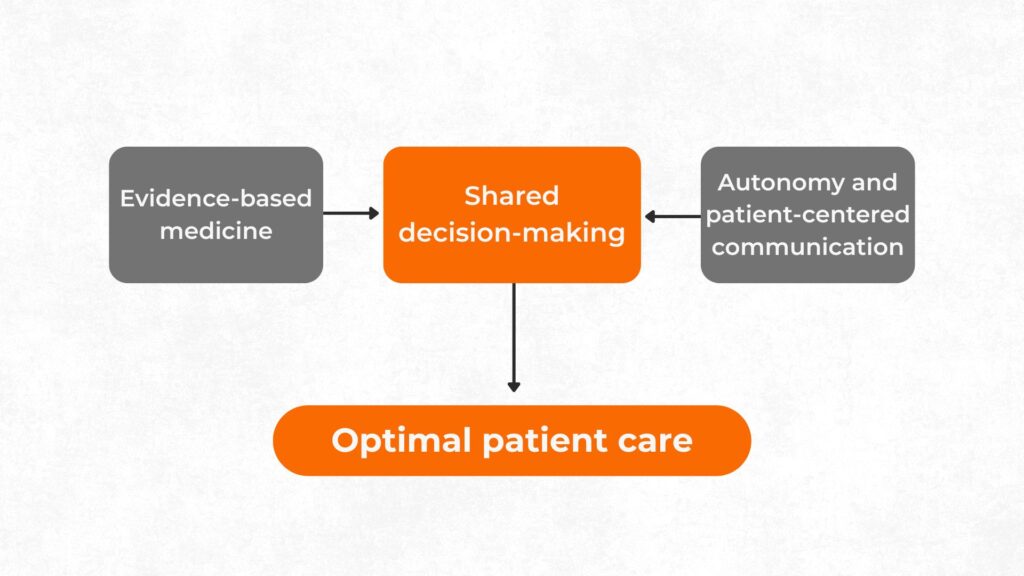
In the case at hand, a shared decision-making model means that the role of the U.S. Ski Federation’s medical services was to assess Vonn’s injury and establish a clinical judgment of its impact, informing her of what she had, what it involved, and what the risks were. And for her to make her own personal assessment of the risk-benefit balance.
If she decides to take the risk, doing things properly includes informed consent and liability waiver documents from the federation. We do not know what procedures of this kind were carried out in Vonn’s case, but in a litigious country like the United States and its culture, they surely know how to proceed.
And if we go one step further, if in the presence of any level of risk healthcare professionals issued “not cleared” decisions, how many athletes at the Milan-Cortina Olympic Games would not have competed?
Federica Brignone, ACL tear plus tibial plateau fracture just nine months earlier. Double gold medallist. Breezy Johnson, the winner of the race where Vonn had her accident, comes from a significant history of knee injuries. We see them in their racing suits, but underneath them, how many come with a history of injuries with lasting consequences or suffer from chronic pain? Where would the line be in elite sport?
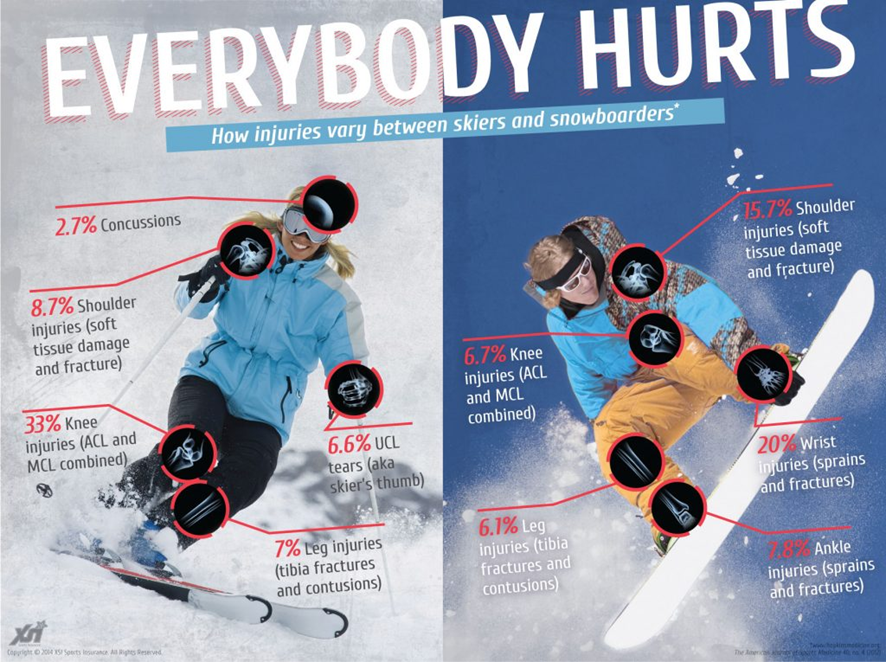
In Alonso’s case, shared decision-making was carried out and it turned out well. And there has been nothing but applause. And if it had gone wrong? The applause should have been the same, not because of the result, but because of her involvement in making the decision.
And for that very reason, far from being excessive ego, Vonn was an informed patient. Her medical team did their job, she made the decision. Therefore, the healthcare professionals were not irresponsible; if anything, she would be (and now we move on to that, because not even that). So, saying that the medical services who treated Vonn were not responsible is not understanding the responsibility each of us has, and which should always come first.
Vonn has served as an example, both to athletes and non-athletes, of the involvement and individual responsibility that anyone should assume when making decisions about their health. Just as when she considered getting a prosthesis, she did not exactly say, “doctor, put in whichever one you think is best.” And, in addition, she has shown complete coherence after her accident. And the medical services, likewise, are an example of how to involve patients and dignify them by humanising our practice.
Because being an informed patient, not a distrustful one, is one of the greatest predictors of a successful recovery. Or perhaps not in elite sport, but certainly of the peace of mind that comes from always having the conviction that you have chosen based on and for yourself. Thank you again, Lindsey.
BEFORE THE NEW INJURY: MENTAL HEALTH AND SOCIAL STIGMA
For anyone, even for the newly labelled heroine Lindsey Vonn, it must be very painful that people she respects question her mental health, simply and from the outset, for the fact of returning to compete at 41 with a knee prosthesis. Beyond the initial thought of whether that might be harmful for the prosthesis, which can even be reasonable, the problem lies in all the assumptions that come afterwards.
As for the prosthesis, as a professional I would tell them not to worry. Improvements in materials today offer very good durability and, although given Vonn’s age it is likely that she will need a revision in the future, that does not justify her having to remain inactive in order to prolong its lifespan. Quite the opposite: prostheses are implanted so that people can return to being active. And an activity like skiing, even if demanding, is not comparable to deciding to take up running four marathons a year. But even beyond that, how she chooses to use it is entirely her decision.
And, having clarified this, the comments could (must) have ended there. But then come the assumptions that follow.
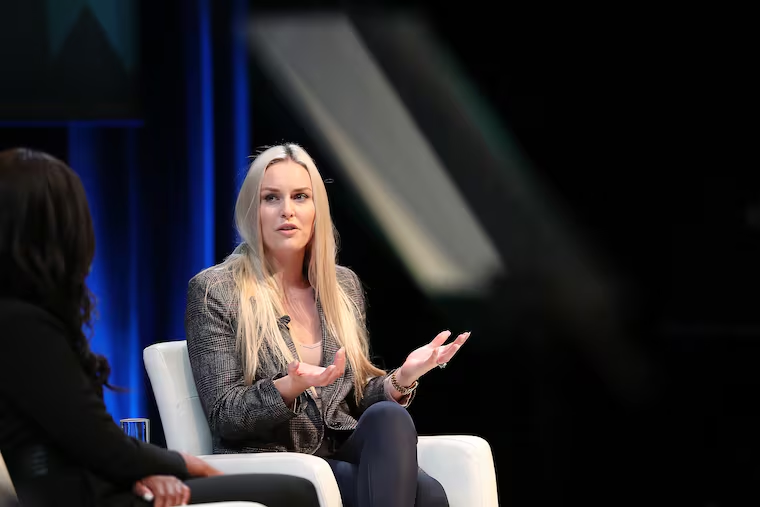
Vonn, a woman, 41 years old. If her life were complete, “she wouldn’t need to prove anything,” so she must be doing it for that reason. “The classic problem of identity crisis after retirement from sport,” like what happened to Michael Phelps. I wonder if Vonn had a family, whether she would have been judged in the same way or if, on the contrary, she would have been applauded as the exemplary super-mum who inspires her children and has the merit of returning to exceptional physical condition after pregnancies, enough to lead a World Cup and compete again in the Olympic Games. That would have been considered merit, and not recovering from a prosthesis, that must mean your life is empty, right?
“At your age.” As if success in life at 41 were not skiing, but meeting other standards. And as if the stopwatch in ski races cared about age.
All of this would make me ask those people who questioned her where their doubts were really coming from: whether from concerns about skiing being harmful for the prosthesis or, in reality and deep down, from all those social stigmas that we all, including them and therefore Vonn, are expected to comply with.
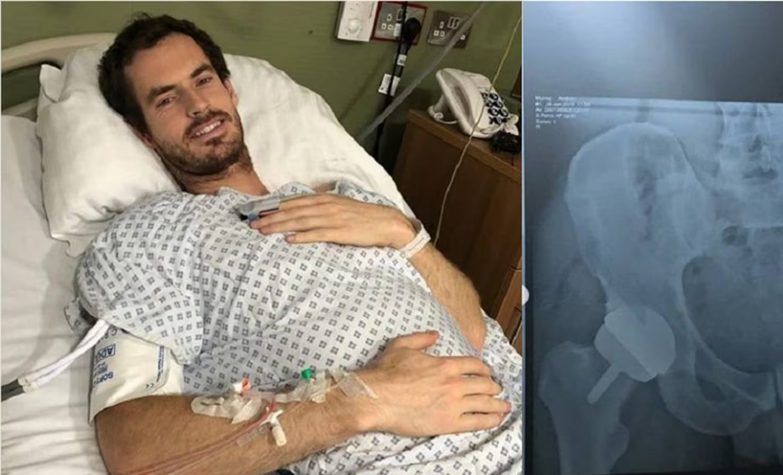
Lindsey Vonn announced her retirement on February 1, 2019. It so happens that just three days earlier, on January 29, 2019, tennis player Andy Murray underwent surgery to receive a hip prosthesis and returned to professional competition in doubles at the Queen’s tournament in June. At that time, it was also questioned whether this was possible with a prosthesis, since he was the first professional tennis player in this situation, but from then until his retirement at the Paris 2024 Olympic Games, no personal judgments were heard about his mental health—about whether he was going through an identity crisis or whether he needed to see a psychologist. I do not agree with a kind of feminism that reduces women to a block in which we all have to think the same way, and even less with one that places us as victims. But, considering this example, I wonder whether the fact that Vonn was a woman influenced those stigmas.
Unfortunately, something tells me the answer is yes, especially when, at the end of 2024, Austrian skier Marcel Hirscher reappeared at the same time as Vonn. With two gold medals and nine World Cup titles, he was the absolute dominator in slalom until his retirement, coincidentally, like her, in 2019. And in his case, he also received criticism, such as claims that he was doing it for marketing now that he had his own ski brand, that he wouldn’t perform the same, or for switching countries and now competing under Dutch nationality. But regarding his mental health, identity crisis, or whether he needed a psychologist… not a single comment. Close the door on your way out.
When I heard her respond in the CBS Sunday Morning interview to those comments from people she knew who, as she explains, did not first sit down with her to ask her directly, I began to realise the magnitude of the situation we are facing.
Listening to her in that interview, I thought something completely different: what a privilege and what a beautiful moment it is to be in a position to return to doing what you love simply for that reason. When you have already achieved records, you do not need income, with no pressure for results. With the added maturity after a retirement in which you have even stepped outside the role of athlete. Purely and exclusively for the passion you feel for it. It seems to me a situation of absolute privilege that occurs in very few cases among athletes.
Personally, I see it as the opposite if you look at it from the individual. If you look at it from society, the stigmas appear, and then the judgments. Because those criticisms could perhaps only have been made by people close to her who truly know her, and if her narrative had been different.
When I read the book by tennis player Arantxa Sánchez Vicario, there were parts that would have concerned me if a friend had told them to me in the first person. Seeing how things later unfolded for her, I have often thought that I would like her to write another one now, to know her reflections with perspective. Hearing Vonn say that she wrote her book from a very dark place, I suspect that if I had read it, I would have felt the same (and perhaps that is why I also now suspect why I did not find it in stores, another sign of growth).
But listening to her now, in the present, on CBS Sunday Morning, it is something for both her psychologist and herself to give each other a well-deserved pat on the back. A true example for every athlete and, in general, for everyone, explaining the difference between the skier and Lindsey. And here she demonstrates one of the greatest lessons we can take from her story: that the purest essence of our actions should be our passion for them.
Sometimes we have to do things that we are not passionate about. Sometimes what we are passionate about comes mixed with many other things we do not enjoy as much (for example, skiing, but not the hours of loneliness in hotels or the demanding schedule away from home). But when we can do what we are passionate about without any added burdens, that is called a luxury. And it does not have to be expensive or inaccessible, but we are so disconnected from that, in a society that has confused it with consumption, that it seems unthinkable that someone could afford it. And all Vonn was doing was allowing herself that luxury.
I once read in a book that “no one has ever become rich doing something they did not enjoy.” And it is true, because that passion is what drives interest, dedication, curiosity. Looking at Vonn’s case, it should remind us that the most effective fuel for our engine is what we like, without thinking about whether I am too young, too old, too tall, too short, too capable, too incapable, or whatever it is that crosses my mind (or others’). And, on top of that, to fight to allow ourselves that. Thank you again, Lindsey.
AFTER THE NEW INJURY: RECKLESS OR A HEROINE?
And now, speaking about her own decision after sustaining the ACL injury, the final question. Was she reckless in deciding to compete? Or quite the opposite? A heroine, an example of courage?
Final veredict: reckless
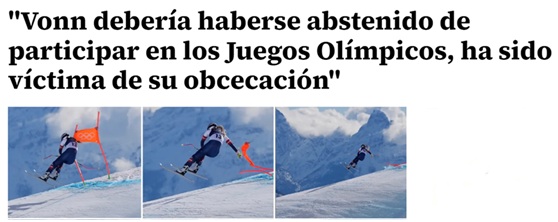
Well, looking at the outcome, many will say that it proved to be outright recklessness. We have already explained that, based on what happened, we will always be left with doubt, given that it was an accident with the gate.
But in reality, perhaps the question itself is wrongly framed, because the verdict cannot be related to the outcome but to how the decision is made.
It would have been reckless to make this decision under two circumstances: first, without having any idea of what downhill skiing is and the risks it involves. And second, without having any idea of what it means to live with the long-term consequences of a knee injury, and the degree of pain and disability it entails. And, as it happens, Lindsey Vonn must be among the top three people in the world who know the most about both.
Therefore, together with the information provided by the medical team about the injury she had sustained, it is simply impossible that her decision was made recklessly.
This is demonstrated in the press conference she gave to announce that she would continue competing, even though from that point on she was labelled otherwise. Because anyone who listened to her speech, and not just to her decision, did not hear something like “I’m going out to win gold no matter what,” but rather “I’m going to give my best, even though I know my chances are not the same”. My best while accepting the situation I am in and of which, as I show, I am fully aware.
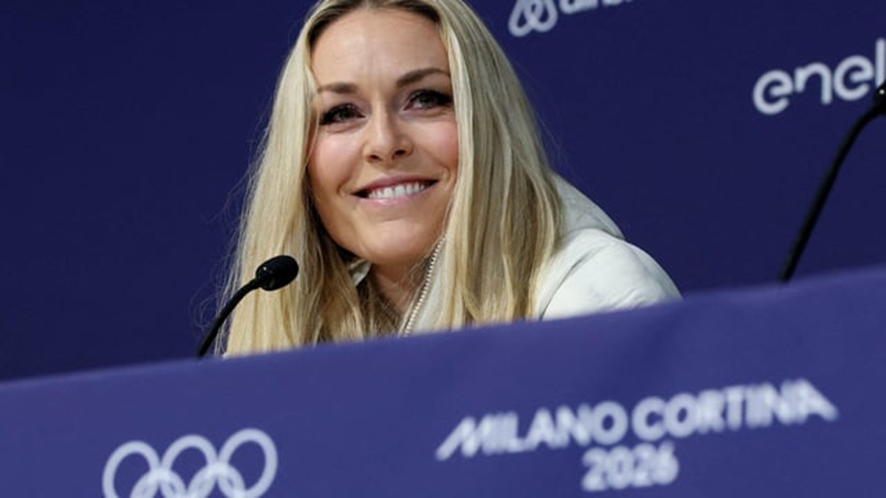
We are talking about the fact that the difference between the winner and the last finisher in the final was 1.19 seconds. That is what Vonn meant by her chances and, although spectators unfamiliar with skiing might not have been aware of it, she certainly was.
That it was risky, of course, but those are two different things. Taking risks is something every skier accepts and that surely falls within what is normal for them. In fact, those who take the most risks are the ones who achieve the most, because they have to push the limits. “Go big or go home.” Some sports are about exactly that. Just ask motorcyclists, surfers or climbers. If these sports were labelled as recklessness, they would have to be banned altogether.
We are at that time of year when physiotherapists start seeing the first amateur skiers of the season, and I get tired of writing in medical records: “the binding did not release.” This is something we emphasise a lot because, simply by not being aware of how to properly adjust their equipment, many recreational skiers end up in the operating room. Last week I saw one of these patients who had lost 15 kg compared to the previous year and had not thought to adjust his bindings to his current weight. And he was surprised that Vonn’s did not release despite the speed of the impact. Of course—this is elite sport, which is synonymous with risk. Is it reckless to adjust them and risk injuring your knee, or to have them release too easily and lose the race you have spent so long preparing for?
And risks, even on a smaller scale, we all take them every day. Otherwise, we would not change jobs, get on a plane, or talk to someone new.
When I was 9 years old, I had an accident playing hockey and, when I returned, my coach asked me if I was going to quit. My mother will always remember that I answered, “no, this was just an accident.” At 17, I witnessed an opponent lose an eye after making a challenge incorrectly. I did not stop playing either. Sitting on a couch eating popcorn is certainly safer—but alredy dead.
In life, each of us chooses the magnitude of our risk. For some, what they love is the speed of downhill skiing. Others die ski touring in an avalanche, and it is said of them that they died doing what they loved. For me, it would not be worth it, but what about for them? And that is where individual freedom comes in. The one that is so often talked about, for which humanity has fought so much, but which this case has shown us that, even if we think otherwise, we still have a long way to go.
Final veredict: heroine
So then, we have it: Vonn is a heroine for daring to take the risk. An example of courage worthy of admiration.
The day after her crash, she shared on social media a photo of herself getting caught on the gate along with a clear message: “I don’t regret it.”
It happened that, almost at the same time, our Carolina Marín shared a photo of her knee after telling us that she had undergone surgery again, a year and a half after that fateful day in Paris 2024. She had undergone a double meniscectomy due to pain that, she explained, was not improving. With it, she also shared a clear message, until later she announced her definitive retirement from badminton:
“I am learning to prioritise my health above any goal. Today, my greatest wish is to take care of my body and have health for the rest of my life”
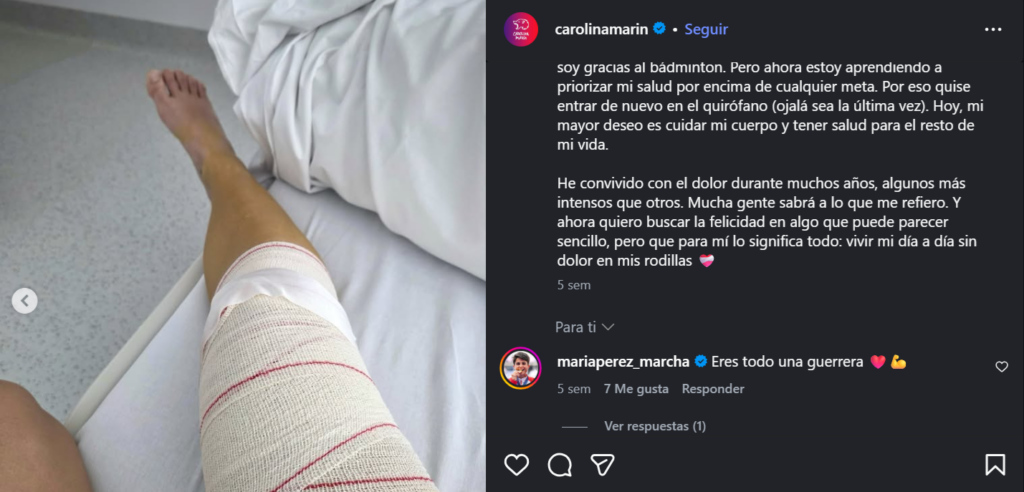
f Vonn is a heroine for daring to take a risk, is Carolina Marín automatically a coward? Would we have used that label for Vonn herself if her decision had been different?
That is why glorifying Vonn, not for respecting herself, or for making her own decisions, or for returning to what she loves despite criticism, but for the mere fact of daring to take a risk, is a very dangerous message for everyone, especially for younger people. And one that has spread like wildfire. As a healthcare professional, I believe it is important to clarify the difference. Therefore, Lindsey Vonn:
Is not reckless
Nor is she a heroine
She is a person
Who has made a decision based on her own personal assessment of the risk-benefit balance that it represents for her, and not for anyone else. And as a 41-year-old woman, having gone through what she has gone through, with full capacity to do so.
ONE MORE ASPECT TO ADDRESS: NEUROCOGNITIVE FACTORS
More? Yes, since I’ve sat down to write, I’m really getting this off my chest. As we have already mentioned, an accident never has a single cause. But that day, as soon as I saw what had happened, something came to mind that I see repeatedly in clinical practice.
In an interview, Vonn is asked why it happened that the year of her divorce was one of the most successful of her career. She married very young, at 23, to fellow skier Thomas Vonn, who also became her coach. Vonn has publicly expressed that mixing her personal and professional life was not a good idea, and that her ex-husband even took on roles such as managing her financial income. And that something very important she learned after their separation was to make her own decisions. Again, we are not just knees.
Vonn responded that it was because she used skiing to avoid thinking about anything else. Many may think that she had a special mental ability to focus so intensely on skiing that, no matter how much she loved it, she could detach herself from the emotions or disputes of a divorce. And that is probably true, but when performing this type of activity, it is not that difficult.
It has been shown that when you perform a high-risk task, the brain detects the threat and activates the sympathetic system. Attention automatically narrows and mental noise decreases. In neurobiological terms, the brain enters survival mode and cannot afford to think about an argument or an unpaid bill. And this is why many people find satisfaction in risky activities, because they force attention onto the present moment.
If you do not like taking that kind of risk, you should know that there is another way to reach this state: meditation. The foundation of meditative techniques is precisely being present—without thinking about what you did yesterday or everything you will do next, placing all your attention on the moment. And, as Joe Dispenza says, “where you place your attention is where you place your energy”. In this way, you eliminate the familiar past that leads you to create a predictable future.
The risk involved in skiing meant that, for Vonn, it served as a form of meditation. Athletes are aware of the benefits of these kinds of techniques for their preparation, and that is why many have incorporated them, along with others based on neuroscience, such as visualization. Images of skiers carrying out these practices before competitions have, in fact, gone very viral during the Milan-Cortina Olympic Games.

But why talk about attention in injuries or accidents?
In the world of knee injuries, one of the topics most widely researched today is neurocognitive factors. What are they? All the variables that your nervous system processes when performing a movement. And we call them variables because they vary: that is, when a skier makes a run, they are not only thinking about how their knee is positioned, but also about the resistance, or lack of it, that the slope offers in that small patch they encounter, the visibility of the day, how the wind is blowing… In other contact sports, such as football, they include the movements of the opponent you are tracking in order to take the ball away.
In other words, neurocognitive factors are the entire attentional demand you have when you move. The nervous system gathers all that information at the same time, processes it together and produces responses in the form of movement commands to your muscles. Like a large control centre, like Houston, processing at high speed.
But in many cases that I see in clinical practice, I ask myself whether we could also consider as neurocognitive factors, beyond the position of the ball and the opponent as described in scientific articles, others such as:
- The rush because I arrived late to handball training? Because I saw a patient at the last minute and closed the clinic late. And on top of that, when I get home, I have to pay an invoice.
- The argument I just had with my ex-wife over custody of the kids before stepping onto the court for a soccer match with my friends?
- The pressure because I did not really feel like playing with that team that season?
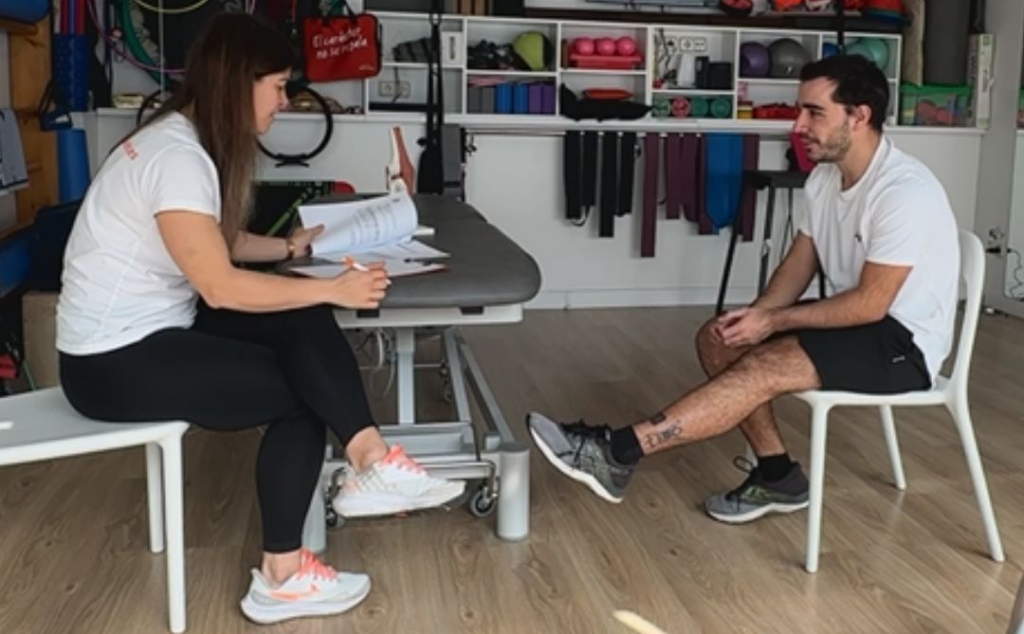
Does that also take up your attention while you are performing the task? That is why, in my experience, neurocognitive factors go even beyond what we can capture in scientific articles. I knew that the day I went down to hockey training thinking about something else was the day I ended up taking a stick to the ball. Years later I learned that science had a name for that, and that the multitasking mode of today’s society may have a lot to do with the incidence of knee injuries.
All these examples are cases of patients I have had, and I could write an endless list. But, at first glance, we would say that this did not affect Vonn, because the risk involved in skiing automatically forces the brain to narrow its focus.
What I asked myself at the moment of the accident was whether all the criticism she received upon her return, the criticism after her injury, and that pressure to achieve something remarkable acted as neurocognitive factors. And, this time, unlike during her divorce, whether not even speed was enough to reduce all that noise, and whether it caused the Houston control centre to collapse. A noise greater than that of a divorce, an excessive and unfair noise, competing for her attention in that moment and causing that, just 13 seconds in, at the fourth gate, she made a technical mistake.
Just as Vonn firmly stated that her ACL injury had nothing to do with the accident, if I could ask her this question, I would love to hear her say that neither did this. Because it would make me truly sad to think that all those criticisms and judgments from a hypocritical society that believes itself to be free and advanced—yet has shown how much ego remains to be refined, could have negatively influenced a woman who, in 2026, was simply trying to do something she loves without affecting anyone but herself.
I would not say that society would then have been complicit, because that would place Vonn in the position of a victim and, therefore, dependent on her environment rather than on herself. But I do believe that, in addition to sharing stories about the bombings in Iran or the violence in Gaza, this case has been an opportunity for deep individual reflection on the, at first glance, insignificant actions we carry out every day, if we truly want to make the world a better place.
CONCLUSIONS
Lindsey Vonn seems to have returned, ironically or not, to square one: a tibial fracture and a torn ACL, now in the other knee.
Her first message was that things had not ended the way she wanted, nor were they the ending of a fairy tale, and that was simply life. And that many times we do not achieve our dreams, but that this is simply part of their beauty.
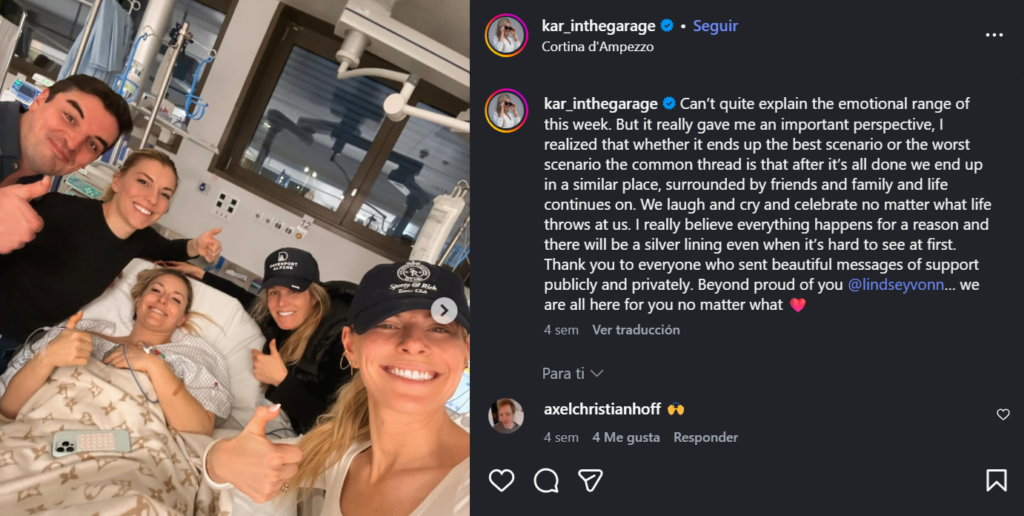
Her sister Karin shared another image where she said that hospital corridors were not where they would have wished to end the Olympic Games, but that she realised that whether they ended in the best or the worst possible scenario, they always ended in the same place: surrounded by family and friends, and that life goes on. That they laugh, cry and celebrate regardless of what life brings them, because everything happens for a reason and there will always be something positive, even if at first it is hard to see.
Life will go on, just as it will for Ana Alonso with her medals or for Sturla Holm without a girlfriend. Good and bad things will come to all of us, and we will have to live through them. And in those two messages, you can read between the lines that level of humility you reach when you realise that there is a perfect balance in the universe between your plans and those that life, the one we have come here to experience, has for you. Hopefully, those are the conclusions that reach everyone from this story, and not that of the skier who thought she was Superman.
That is why Vonn does not return exactly to square one. She is now a different person from who she was in 2013, with much more lived and learned, and surely this situation will lead her to experience many new things necessary on her path.
Reflecting on the case of Lindsey Vonn, I have found many things that I admire about her and that, as I have explained, have nothing to do with her decision to take a risk. That was a choice she made.
Things such as being guided by what she is passionate about without being led by social stigmas. For respecting herself, for being able to choose for herself, and for her absolute coherence, and I believe that if everyone were that consistent, this world would be very different. I also praise her humility and acceptance. But above all, I admire what she has been able to do with her pain.
In another of the many interviews, Vonn explained that she is convinced that we are all here for a reason, and that she learned that her mission was not to be a skiing star, because her greatest fulfilment had not come from winning medals, but from every time she had helped others. That is why she created her foundation for girls and adolescents, with all those objectives that could be summed up in one: teaching them to believe in themselves. In every podcast I have listened to, I have seen a person who dares to show her vulnerability to help others normalise it, and who has dedicated herself to creating and working to spare many people what she herself went through. That is why, above all, what I have found admirable in her is that she has been able to live her pain, accept it, understand it, recognise its role in shaping who she is today, and transform it in order to help others. For using her pain in the service of others, my respects to you, Mrs. Vonn.
One afternoon in the park with a friend of mine, we were talking while her children were playing. And, looking at them, she said to me: who would we have been if we had been given even a minimum of confidence in ourselves? It is a good question, but over the years I have learned that it does not make sense to ask it. Because you are always in time to become the person you would have liked to be, regardless of your past. It is called neuroplasticity, and I found it very interesting to see freestyle skier Eileen Gu explain this very idea in a press conference at these Olympic Games. Therefore, believing in yourself is something you are always in time to learn, but only after making that firm choice every day.
Being an example of believing in oneself is the phrase with which I could summarise everything I find admirable about Lindsey Vonn. Her story has meant a lot to me, and there are things I have decided to remind myself of every day. My way of thanking her will be to follow what she shares and to send her a little of my attention, and therefore my energy, so that she can continue living what lies ahead, putting all the love possible into it.
Through this article, I hope I’ve been able to help you as well, and to contribute to turning things around so that, rather than being about judgment, criticism, and pain, it becomes something that inspires us, encourages us to support one another and helps us believe, firts of all, in our own selves.


Deja una respuesta